A pilot CV should let a recruiter check your eligibility without hunting through a career story. Put your licence, relevant hours, recent flying, work rights and availability near the top, then show the training and employment history that supports those figures.
This guide provides a practical structure for newly qualified and experienced pilots. It is an editorial template, not an airline-approved form. Follow the vacancy’s instructions whenever they specify a different format or application process.
Free pilot resource
A clearer CV. A stronger first impression.
Download the redesigned, editable Word template. Present your qualifications, dated flight hours and experience in a clean layout that is easy to scan.
Download the Word templateFree · No account needed · Editable .docx · Replace every placeholder before applying.
The template is a starting structure, not a completed application. It contains no invented flight hours, endorsements or employment. Replace every bracketed field, remove unused entries, and export to the format requested by the airline. Keep document scans separate and submit them only through a verified recruitment process.
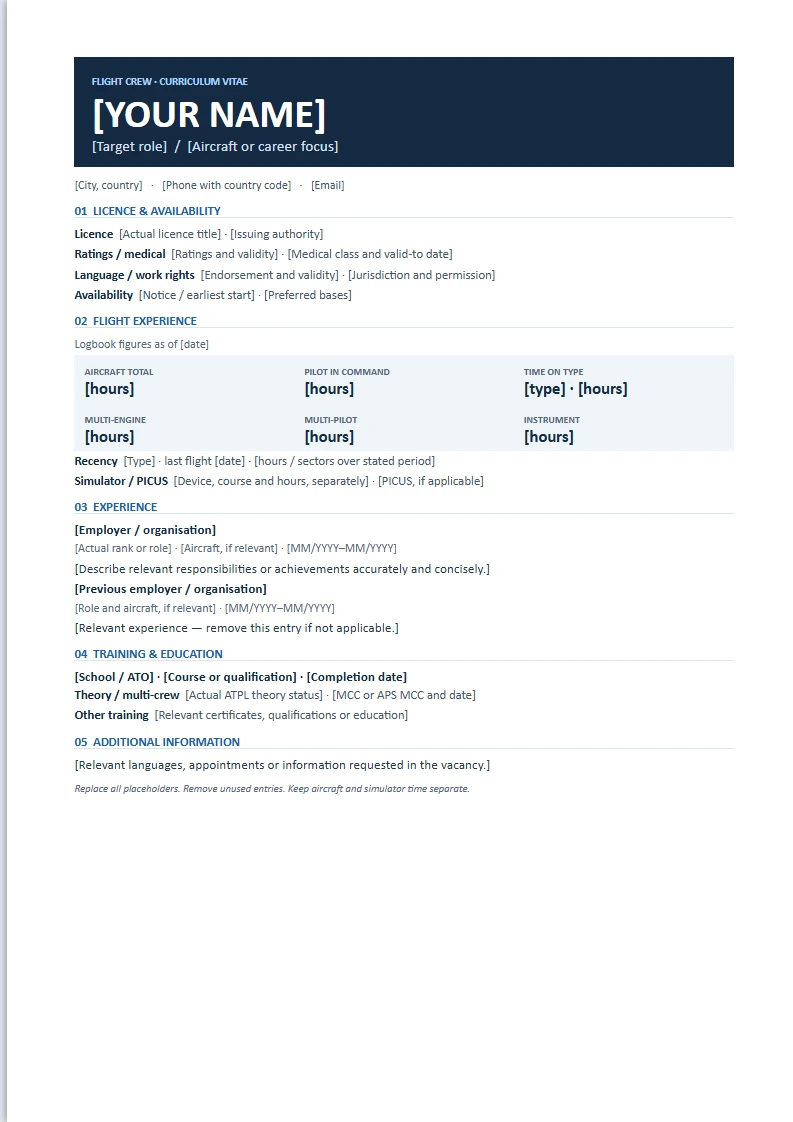
Lead with licence and availability, then dated hours, recency and evidence. Replace every placeholder and keep aircraft and simulator time separate.
Source: Download the editable Word template. View full-size image (opens in a new tab)Start with the actual vacancy
Before writing, save the advert and make a short list of its eligibility requirements. Check the employing operator, rank, fleet, licence authority, work rights, total hours, time on type, recent flying and required training certificates. Mark each item as met, not met, or requiring clarification.
If a role requires 500 hours on type, buying a rating does not satisfy that experience requirement. If it specifies a particular licence authority, describe yours accurately rather than substituting a broad label such as “European licence.” Our analysis of pilot vacancy recency requirements explains why dates and current experience deserve space alongside total time.
What to put in the first third of your CV
- Contact and target: name, professional email, phone including country code, city/country and intended role.
- Licence and medical: actual licence title and issuing authority, relevant ratings, medical class and validity, and language endorsement.
- Flight experience: relevant hour categories with an explicit “as of” date.
- Recency: last flight on the relevant type and recent hours or sectors where the vacancy asks for them.
- Eligibility and availability: work permission for the advertised jurisdiction, notice period, earliest start and realistic base preferences.
A short profile can help if it adds concrete information: “CPL(A) holder issued by [authority], seeking [role], available from [date].” Avoid a paragraph of unsupported adjectives. The figures and records below it should carry the application.
Present flight hours without double counting
Use the categories in the advert and reconcile them with your logbook. Total aircraft flight time, PIC, multi-engine, instrument, multi-pilot and time on type can overlap; adding them together can produce a false total. State simulator experience separately and identify the device or course where relevant.
| Field | How to make it clear |
|---|---|
| Total aircraft time | Give the logbook total and the date on which it was calculated. |
| PIC and PICUS | Separate them if requested; do not relabel supervised time as unrestricted command time. |
| Time on type | Name the type and distinguish aircraft experience from training-device time. |
| Recent experience | Name the period, type and hours or sectors; avoid the vague word “current.” |
| Simulator training | List separately from aircraft totals and match the employer’s requested categories. |
For a period without flying, give an accurate last-flight date and explain any relevant refresher training separately. A clear gap is easier to discuss than a recency claim that changes between the CV, portal and logbook.
For newly qualified pilots: lead with training and evidence
Use a concise training timeline with school, course, qualification and completion date. Identify MCC or APS MCC accurately, rather than treating them as interchangeable. List certificates you actually hold; explain an expected completion date if the airline permits an application before completion.
“Frozen ATPL” is common industry shorthand. Give the actual licence, ratings and theory status as well; our frozen ATPL guide explains the distinction. For non-flying work, select responsibilities that demonstrate preparation, teamwork, customer handling or accountable decision-making. Describe what you did, without inventing cockpit experience.
Keep training records ready for the portal. For example, Ryanair’s recruitment FAQ asks cadets for a signed flight-school report and directs applicants to upload requested documents through their existing profile. A polished CV does not replace those requirements.
For experienced pilots: make the operational record easy to check
List employers in reverse chronological order, with month/year dates, actual rank and aircraft. Give the scale and scope of the work where useful, but avoid copying confidential operational information. Distinguish acting duties, formal appointments and completed qualifications.
If you changed fleet or stopped line flying, ensure the rating-validity and recency lines still describe your present position. Put instructor or examiner qualifications in a separate section when relevant. Avoid implying a current appointment simply because you held it previously.
Keep the layout readable and the application consistent
Aim for a concise document that accommodates your experience; one or two pages is a useful editorial target, not a universal airline rule. Use ordinary headings, selectable text and a clear font. Avoid skill-rating graphics, decorative cockpit images and information available only in a header or image.
Use a filename such as Firstname-Lastname-Pilot-CV-2026-10.pdf. Open the export, select and copy its text, and check that the reading order still makes sense. Review it on a small screen as well as a desktop. PDF is appropriate only when the employer permits it: GetJet’s general careers form, for example, identifies PDF as its supported CV format.
Reconcile the portal, CV and supporting documents before submitting. Store the vacancy URL, submission date and the exact CV version in the pilot application tracker. Follow the employer’s contact policy; do not send unsolicited copies merely because you have not received an answer.
Before you press submit
Your final CV check
A few deliberate checks make the application easier to verify.
Match the vacancy
Check the advertised licence, work rights, hours and training requirements against your own records.
Reconcile your figures
Recalculate the hours, add an as-of date and verify rating, medical and endorsement descriptions.
Make the template yours
Replace every placeholder, remove unused entries and check contact details, dates and spelling.
Check the export and submit
Open the requested file format, confirm readable text and upload the required documents through the airline’s official route.
Keep the submitted CV version and vacancy link in your application tracker.
Frequently asked questions
Should a pilot CV include a photograph?
Use one only when the employer requests it or you have a specific reason that fits the application requirements. The template omits a photo to give eligibility and experience more space.
Should I include passport and licence numbers?
The template does not request them. State the relevant authority and work eligibility, then supply identifiers or scans through the verified portal if required.
Can I use the same CV for every airline?
Keep one accurate master record, then adjust the target role, order of relevant experience and requested categories for each application. Your underlying facts must remain consistent.
Sources and next steps
Employer process examples were checked on 2 October 2026: Ryanair recruitment FAQ and GetJet careers. Layout and workflow suggestions are Fly.hr editorial guidance, not published selection criteria. No airline has endorsed this template.
Once the paperwork is ready, use the interview guide and simulator assessment preparation guide to plan the next stage.