
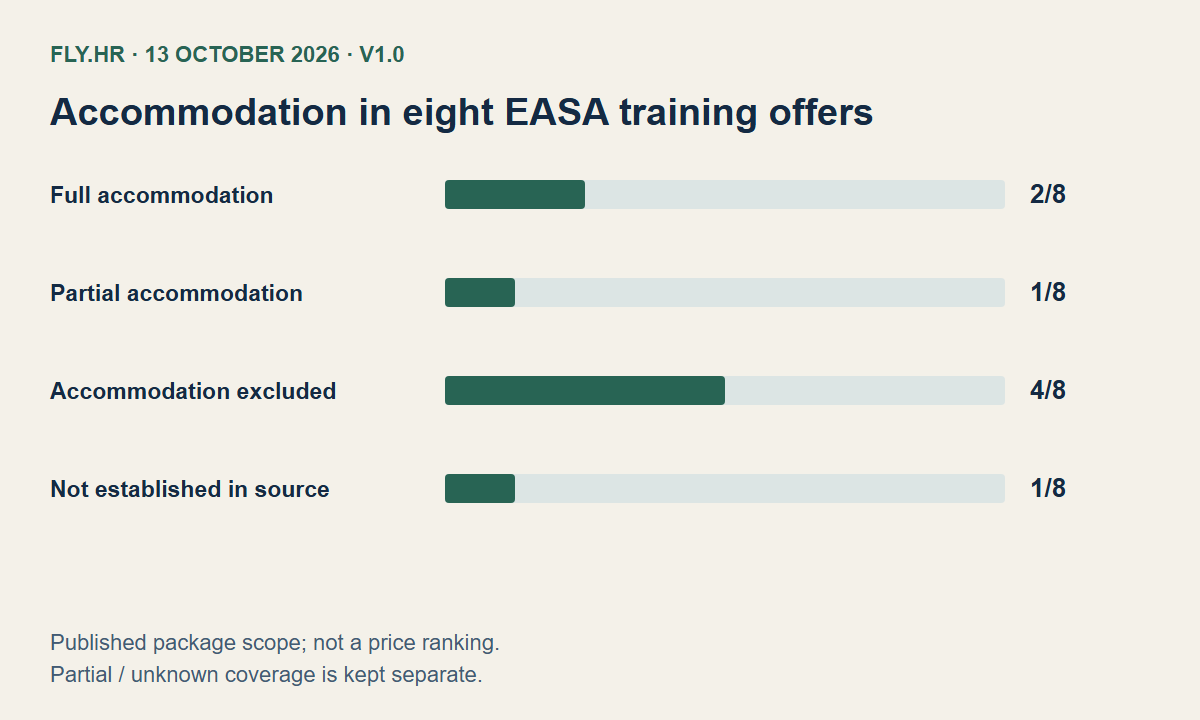
Fly.hr compared eight selected published EASA integrated pilot-training offers on 13 October 2026: six standalone programmes and two airline-linked EU pathways. Displayed fees ranged from €79,500 to €130,000, but the packages were not equivalent. Two included full ordinary accommodation, one covered only part of training, four excluded it, and one did not establish its status in the selected source.
This comparison helps you turn a public course price into an itemised budget. It records what providers publish, including omissions and intake qualifications. It is not a ranking of school quality or an estimate of the average cost of becoming a pilot.
The offers prepare students through integrated training marketed as “frozen ATPL” or an airline-entry course. They should not be understood as issuing a full ATPL without the required later experience. EASA’s ATP integrated-course manual explains the training framework; the licence terminology guide explains the distinction.
Original research · Version 1.0
Compare the terms behind the price
The eight-row dataset preserves offer scope, intake year, accommodation, examination/medical treatment, MCC and airline type-rating conditions. The bundle includes the coding, provenance, methods and a blank budget worksheet.
Download observations (CSV)Methods and data dictionary (TXT) · Complete research bundle (ZIP)
Six standalone integrated offers
| Official programme source | Published fee and qualification | Ordinary accommodation | Published duration |
|---|---|---|---|
| FlyBy Integrated ATPL, all-inclusive package | €79,500 Undated current programme display; obtain intake-specific quote. | Full residential coverage stated Single room/private bathroom and full board for advertised programme period. | From 14 months |
| BAA Training ATPL Integrated, base course | €85,500 Undated current base-course display; optional type-rating price not included. | Accommodation excluded Accommodation/living listed outside price; optional booking available. | 18-22 months, depending on sequence/progression |
| airBaltic Training Self-sponsored ab-initio ATPL course | €89,000 Undated current self-sponsored course page. | Accommodation excluded Living/subsistence excluded; accommodation assistance does not make housing included. | Approximately 24 months |
| Quality Fly Integrated ATPL, 2027 promotional offer | €96,000 Explicitly 2027 course offer; not presented as a 2026 intake price. | Accommodation excluded Student housing offered as a separate complementary service; current display from EUR 950 without a payment period coded here. | Not stated in selected pricing page |
| FTEJerez EASA Airline First Officer Programme (AFOP) | €129,500 Courses starting from 1 January 2026; subject to change. | Full residential coverage stated Full-board Jerez accommodation during 62 training weeks; VAT included for stated accommodation/package wording. | 62 training weeks; calendar extensions/holiday closure may apply |
| European Flight Academy ATPL training in Germany | €130,000 Current German cost page; older EUR 120,000 press release excluded. | Only part of training covered Phoenix practical-phase housing included; German theory/practical housing excluded. | Not stated in selected cost page |
A standalone course in this table may have airline relationships or career support. The category means that the selected offer is not one of the two Ryanair-linked EU training pathways below; it does not certify the absence of every employment relationship.
Two airline-linked EU pathways
| Official programme source | Published fee and qualification | Ordinary accommodation | Published duration |
|---|---|---|---|
| Bartolini Air Ryanair Future Flyer Academy, EU ab-initio integrated | €83,990 Current EU pathway display; get intake-specific quote. | Inclusion not established Accommodation inclusion/exclusion not established in selected programme price section. | 18-24 months |
| Atlantic Flight Training Academy (AFTA) EU ab-initio Ryanair Future Flyer Programme | €109,000 Page advertises 2026 and 2027 dates; fee applicability to a particular future intake needs written confirmation. | Accommodation excluded Accommodation/living explicitly excluded. | 18-24 months, progression-dependent |
The EU offers were selected. UK-discounted, modular and separate financing options are not substituted for those fees. A conditional airline offer or an included type-rating pathway still needs its actual training and employment agreements.
1. Accommodation coverage changes the budget

FlyBy’s all-inclusive option publishes residential accommodation and full board. Its same current page also displays a €69,500 basic option; our selected observation is the €79,500 all-inclusive offer. The €10,000 headline difference should not be treated as an isolated housing price without matching the full written package scopes.
FTEJerez’s EASA AFOP sheet includes full-board accommodation during 62 training weeks. European Flight Academy’s German cost page includes Phoenix practical-phase housing but excludes housing for the German theory and practical phases. We therefore code EFA as partial coverage, rather than full residential training.
Training duration may be expressed as months, training weeks or a progression-dependent interval. Obtain the dates housing begins and ends, holiday treatment, the cost of extensions and whether a training delay requires extra rent. Booking assistance is useful, but is not evidence that the fee pays for accommodation.
2. Initial medicals, renewals and first attempts are different items
Quality Fly’s live 2027 price page lists an initial EASA Class 1 examination and loss-of-Class-1 cover within the package. Housing remains a separate complementary service. FTEJerez lists a medical renewal; we do not turn that into a claim that the initial examination is included.
BAA Training’s current integrated-course page lists the initial assessment, Class 1 medical, ICAO English certificate, CAA exams and accommodation/living outside its €85,500 base price. airBaltic Training’s self-sponsored offer includes mandatory exams and licensing/certification but describes extra examination costs following repeated failures.
Ask for the examination allowance by subject or test, the number of included attempts, examiner and aircraft charges, licence issue costs and prices for additional flying. A syllabus can include preparation for an exam while excluding the authority’s exam fee. A first-attempt allowance is not unlimited retakes.
3. MCC and airline aircraft type ratings are separate
The selected offers differ in their stated MCC or APS-MCC scope. Airline-style simulator training does not itself establish an airline aircraft type rating. The dataset keeps the two fields separate and leaves unclear inclusions unresolved.
Bartolini Air’s EU Future Flyer offer lists AUPRT and APS MCC and describes a B737 type-rating pathway subject to a training-cost agreement. AFTA’s EU programme advertises a B737 type rating within its €109,000 fee after successful final assessment. Ryanair’s own Future Flyer page also specifies a training-cost agreement for ab-initio and Gateway 1 ratings. Obtain that agreement before interpreting advertised inclusion as zero financial exposure.
BAA’s base course explicitly treats type rating/base training as an optional paid add-on. This is one reason a headline difference between providers cannot establish the cheaper complete route. The type-rating decision guide helps connect any additional purchase to a recruitment route you can actually access.
4. Use the current offer and its intake qualification
Several useful details would be lost by copying a search snippet. EFA’s live cost page and FAQ agree on €130,000 for Germany. BAA’s live redirected page displays €85,500 for the base integrated course with type rating as an optional paid add-on. Quality Fly’s €96,000 is explicitly a 2027 promotional course offer, alongside a €99,500 regular price.
The FTEJerez sheet checked here is version FTEPS V.2026.02.10 and applies to starts from 1 January 2026. It displays €129,500 for EASA training; the separate UK CAA price is in GBP and is not converted into this table. Older price sheets can remain discoverable after a newer one appears.
A date-stamped quotation should confirm the exact intake, applicable taxes, inclusions, discounts, validity period and payment/refund conditions. We have not inflation-adjusted or normalised these fees into an average market cost.
5. Upfront cash and total fee are different
Published instalments can help establish cash timing. EFA’s six listed rates sum to €130,000; its first €10,000 payment is not the whole course price. FTEJerez’s €5,500 deposit and subsequent instalments sum to €129,500. AFTA’s €2,000 deposit plus four later payments sum to €109,000, so the deposit should not be added again as an extra fee.
AFTA separately lists €79 online and €300 school assessment charges. Its medical and living/accommodation are excluded. Keep these outside the selected course-fee row, and obtain any missing exam, extra-training or refund terms. Loans and income-share arrangements need a separate repayment model; borrowed money does not reduce the training price.
Build a budget you can update
Download the blank pilot-training budget worksheet (CSV). It has rows for course fees, assessments, medicals, exams, additional flying, equipment, housing, travel, finance charges, type rating and the period after training while waiting for employment.
- Enter the selected course fee once. Mark other items included only when the written quotation confirms their scope.
- Price excluded items; retain unknown amounts as unresolved questions instead of treating them as zero.
- Use the provider’s calendar plan for living costs and add a separate delayed-training scenario.
- Separate course completion from an employment start; budget the gap explicitly.
- Keep an airline training agreement’s potential liability visible beside the cash budget, rather than hiding it inside an optimistic monthly salary forecast.
Illustrative arithmetic, not provider data: if your own assumed uncovered living budget is €1,000 per month, a three-month delay adds €3,000. The allowance is a hypothetical input; substitute your actual housing and subsistence quotes. No such estimate is included in the research dataset.
Method and inclusion rules
Sources were collected on 13 October 2026. The unit is one selected published zero-experience EASA integrated offer per provider. Eight providers were chosen purposively for a reviewable public price and useful differences in residential and airline-linked terms. Six offers are standalone and two are airline-linked EU routes. All selected amounts are in EUR. Offers without public prices are outside this price-conditioned sample.
UK CAA-only/GBP routes, modular gateway prices, special nationality/service discounts and financing balances are not merged into the selected fees. The Quality Fly 2027 offer remains explicitly labelled as a future-intake promotion. Offer availability and price applicability must be rechecked with the provider.
Provider pages and current price sheets supply the facts. Complete live HTML/PDFs were retained internally with timestamps and hashes; Quality Fly’s live browser-rendered page was reviewed after a plain automated request was blocked. Older search snippets were not used to override the live source. Public bundle files contain our coding and references, not copyrighted copies of provider brochures.
Full accommodation means ordinary residential coverage for the advertised programme; one overseas phase or an exercise hotel is partial. Initial medical and renewal are separate. Exam allowances preserve attempt limits. Unstated means not established in the selected source, rather than included or excluded. The downloadable dictionary documents every field.
Limits and verification before enrolling
The comparison records advertised terms; it does not independently audit actual delivery, training quality, ATO approval scope, provider finances, graduate employment outcomes or contract enforceability. Check the exact approval and course scope with the competent authority, obtain the written training agreement, and confirm your medical and admission position before committing.
The eight selected providers do not represent every European school. Different training sequences, housing periods, examination allowances, MCC variants, airline conditions and intake dates prevent a defensible cheapest/best-value ranking or an average total cost. Source coding and drafting were AI-assisted, with source inspection and automated consistency/arithmetic checks. Independent human or expert review is not claimed.
Report a correction using the T01–T08 observation ID and an official source through the corrections page. Readers evaluating the employment side can also use the pilot recruitment disclosure audit.
Citation, data and reuse
Suggested citation: Fly.hr Research (2026). EASA Integrated Pilot Training Costs: Eight Published Offers Compared. Version 1.0. Sources collected 13 October 2026. https://fly.hr/easa-integrated-pilot-training-cost-comparison/.
A citable statement with its scope: “Among eight selected published EASA integrated training offers reviewed by Fly.hr on 13 October 2026, two stated full ordinary accommodation coverage, one partial coverage, four excluded accommodation and one did not establish its status in the selected source.”
Original coding and charts are available under CC BY 4.0, with attribution and disclosed changes. Source material retains its owners’ rights. Version 1.0 is a fixed snapshot; later corrections require a new release and dated change note.
Observations CSV · Methods/data dictionary · Reproducible research bundle · Budget worksheet
Programme sources are linked in the tables and dataset. Additional official context: EFA FAQ, Ryanair Future Flyer terms and EASA integrated-course guidance. See Fly.hr’s editorial standards for the publication process.


Comments