

There is no single worldwide ACMI pilot salary scale in 2026. Pay varies by country, legal employer, aircraft, rank, seniority, rotation, and whether the pilot is an employee or an independent contractor. A monthly headline without those details is not a reliable comparison.
This guide explains what can be verified, what cannot, and how to turn an ACMI offer into a realistic annual and take-home estimate.
The honest answer on ACMI salary ranges
Public data does not support one defensible global range for “an ACMI pilot.” Many European and international operators do not publish complete pay scales, while recruitment adverts may show a day rate, monthly retainer, or gross package without explaining guaranteed work, tax, or benefits.
For that reason, fly.hr does not treat anonymous salary submissions or an isolated contract advert as an industry-wide benchmark. A current written offer is more useful than a generic monthly figure.
A useful public benchmark—and its limits
The U.S. Bureau of Labor Statistics reported a median annual wage of $232,140 for airline pilots, copilots, and flight engineers in May 2025. Within its industry breakdown, the median for couriers and express delivery services was $334,930. Commercial pilots had a separate median of $123,220.
These are strong national benchmarks, but they are not ACMI pay scales. They combine different employers, ranks, seniority levels, and working arrangements in the United States. They should not be converted into a European contractor’s monthly salary or used to promise what a particular ACMI operator will pay.
How ACMI pilot pay is structured
Fixed salary or retainer
This is the amount paid each month regardless of actual sectors or duty days, subject to the contract. Confirm whether it is paid during leave, training, sickness, and periods without a customer assignment.
Day, hour, or sector pay
Variable pay may be based on duty days, block hours, flight hours, or sectors. Ask which events count, when the calculation starts, whether positioning is paid, and whether a monthly minimum is guaranteed.
Per diem and allowances
Per diem is intended to cover costs while away from base. It improves cash flow only to the extent that the allowance exceeds actual expenses. Treating the entire allowance as salary can overstate the package.
Travel and accommodation
Employer-paid positioning, hotels, local transport, visas, and tickets home can be valuable. The contract should say who books them, what standard applies, and what happens after a cancellation, reassignment, or early termination.
Benefits and protections
Pension contributions, social insurance, paid leave, sick pay, loss-of-licence cover, medical insurance, and severance can be a large part of employee compensation. A contractor rate may look higher because the pilot must fund some or all of these items.

Monthly pay vs annual pay
First establish what the quoted period means. “Per month” can mean every calendar month, only a working month, or a retainer plus variable duty pay. A day rate may apply only to operating days, all rostered days, or days away from home.
A simple comparison starts with:
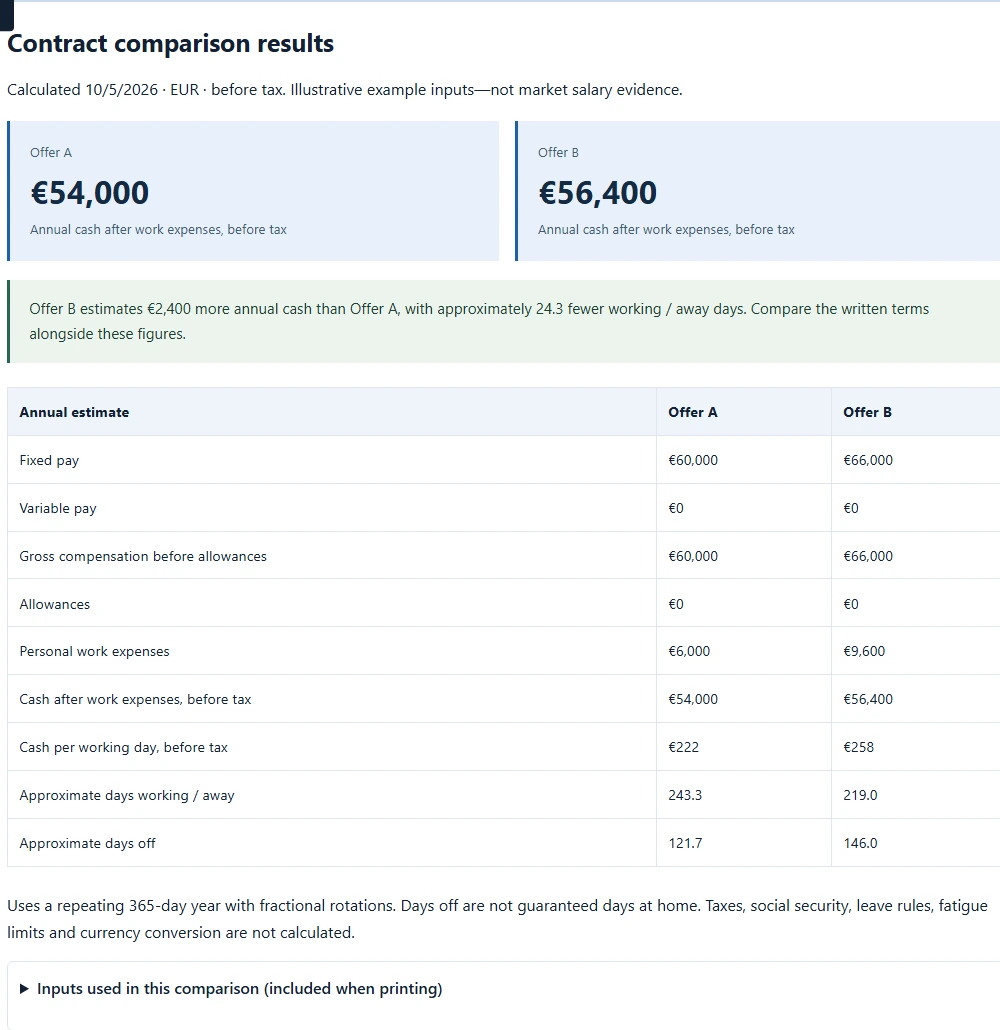
Estimated annual gross = guaranteed fixed pay + realistically achievable variable pay + taxable allowances.
Estimated personal value = annual gross + employer-paid costs − self-funded employment costs − unpaid gaps.
Taxes and social contributions come after that calculation and depend on the applicable country, tax treaty, residence, and employment status.
A hypothetical contract comparison
How rotations affect the package
Our ACMI pilot roster and lifestyle guide explains the terms in detail. Rotations such as 20 days on / 10 off or 21 on / 14 off appear in the market, but neither pattern is universal. The important questions are whether “on” days are paid, how travel days are treated, whether days off are protected, and whether the roster can change after a customer contract moves.
Roster labels do not replace flight-time limitation rules. Operators conducting European commercial air transport must maintain an approved flight-time specification scheme and comply with applicable duty, rest, and fatigue requirements.
Employee vs contractor pay
| Question | Employee package | Contractor package |
|---|---|---|
| Pay continuity | Often monthly, subject to employment terms | May depend on duty days or active assignments |
| Tax withholding | Often handled through payroll | May be the pilot’s responsibility |
| Pension and social cover | Employer contributions may apply | May need to be self-funded |
| Paid leave and sickness | Defined by law and contract | May be unpaid unless expressly covered |
| Termination risk | Employment protections may apply | Notice and payment depend heavily on contract wording |
The label is not enough. Some arrangements described as contracting may legally be treated as employment in the relevant country. Get professional advice where classification is unclear.
The contract questions that change take-home pay
- Is the figure gross or net, and in which currency?
- Which legal company pays you, and under which country’s law?
- How many months, days, or hours are guaranteed?
- Are training, standby, positioning, and travel days paid?
- Who pays for hotels, commuting tickets, visas, medicals, uniforms, and licence work?
- What happens if the customer contract ends or the aircraft leaves the fleet?
- Are leave, sickness, pension, social insurance, and loss-of-licence cover included?
- What is the notice period, and can money be withheld for training or early departure?
Tax residence can change the result
International rotations do not create one simple “pilot tax” rule. The European Union does not set a single income-tax system for people working across member states. National rules, tax residence, the employing entity, where work is performed, and bilateral tax treaties can all matter.
Use the EU’s cross-border tax guidance as a starting point, then obtain advice based on the exact countries and contract. A recruiter saying that pay is “tax free” is not a substitute for a written analysis.
ACMI salary red flags
- A large monthly figure with no definition of guaranteed pay.
- Per diem presented as if it were ordinary salary.
- No named employing entity or governing law.
- Unclear responsibility for positioning, accommodation, and repatriation.
- Payment dependent on a customer contract with no minimum guarantee.
- Requests for substantial upfront payments without clear refund and employment terms.
Is an ACMI package worth it?
It can be. ACMI work may offer aircraft access, international operations, blocks of time off, or a faster move into a desired role. The right comparison is annual guaranteed value and risk—not the largest number in a recruitment message.
Before deciding, compare the package with the lifestyle and progression trade-offs in our ACMI vs legacy vs low-cost career guide. If you are still applying, use the step-by-step ACMI hiring guide.
Sources and methodology
- U.S. Bureau of Labor Statistics: Airline and Commercial Pilots, May 2025 pay data
- EASA Easy Access Rules for Air Operations, including flight-time limitations
- Your Europe: income taxes abroad
- Your Europe: double-taxation guidance
Salary figures are dated to the source period shown. The hypothetical contract comparison is included only to demonstrate the calculation method and is not a survey result or market quotation.
Check the pay terms in your offer
Use the airline offer checklist to distinguish guaranteed pay, variable pay, expenses and training liability. The contract comparator estimates annual compensation from the inputs and assumptions you provide.



Comments